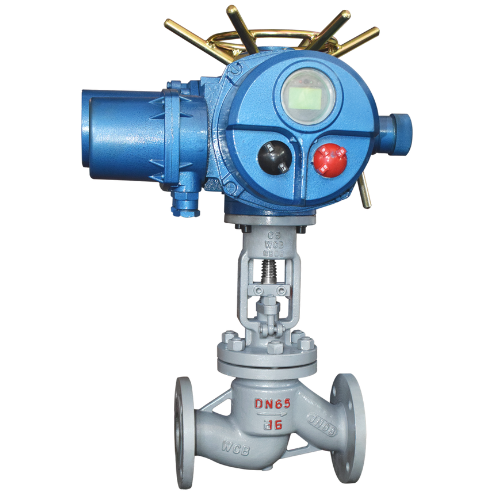
Product Introduction
Cast Steel Electric Globe Valve Overview
Cast steel electric globe valves are designed for high-pressure and high-temperature applications, featuring a cast steel body for durability and an electric actuator for automated operation. They are widely used in power plants, oil and gas, and industrial systems where precise flow control and remote operation are required.
Cast Steel Electric Globe Valve Features
Feature Description
Body Material Cast steel (e.g., WCB, WCC, LCB, WC6) for high strength and durability.
Actuation Electric motor-driven actuator for automated control.
Temperature Range Suitable for high temperatures, typically up to 425°C (800°F) or higher.
Pressure Rating High-pressure applications, commonly ANSI 150 to 2500.
Sealing Metal-to-metal or soft seats (e.g., PTFE, graphite) for tight sealing.
Applications Power generation, oil and gas, chemical plants, and steam systems.
Voltage Options Standard voltages: 24V, 110V, 220V, 380V AC/DC.
Advantages High durability, automated operation, and suitable for extreme conditions.
Disadvantages Higher cost, requires power supply, and regular maintenance.
Standards Compliant with API, ANSI, ASME, and DIN standards.
For more detailed specifications, refer to manufacturer datasheets or industry standards like API 602 for cast steel valves and ISO 5211 for actuator mounting.
1. What is a globe valve?
A globe valve is a type of valve used to regulate or control fluid flow in a pipeline. It consists of a movable disk (or plug) and a stationary ring seat, which work together to throttle or stop the flow.
2. What are the main applications of globe valves?
Globe valves are commonly used in applications requiring precise flow control, such as:
Cooling water systems
Fuel oil systems
Chemical processing
Steam systems
High-pressure and high-temperature systems
3. Can globe valves be used for on/off service?
Yes, globe valves can be used for both on/off and throttling services. However, they are more commonly used for throttling due to their design, which allows for precise flow control.
4. What are the advantages of globe valves?
Excellent flow regulation and throttling capabilities.
Good sealing performance with minimal leakage.
Suitable for high-pressure and high-temperature applications.
Available in a wide range of materials and sizes.
5. What are the disadvantages of globe valves?
Higher pressure drop compared to gate or ball valves.
Heavier and more complex design.
More expensive than some other valve types.
Not ideal for slurries or viscous fluids due to potential clogging.
6. What are the different types of globe valves?
Globe valves come in three main body designs:
Tee Pattern (Z-body): High pressure drop, used for throttling.
Angle Pattern: Changes flow direction by 90 degrees, reduces pressure drop.
Wye Pattern (Y-body): Low pressure drop, suitable for high-flow applications.
These FAQs provide a basic understanding of globe valves and their applications. For more detailed information, consult manufacturer specifications or industry standards like API 602 or ASME B16.39.